

dari.yml with harness: <name>.
Distributed by design
Most harnesses run as a long-lived process on a sandbox — it stays pinned for the whole conversation, and if it dies the session dies with it. Dari pulls the loop out of the sandbox and drives it from the control plane, touching the sandbox only when a step needs it.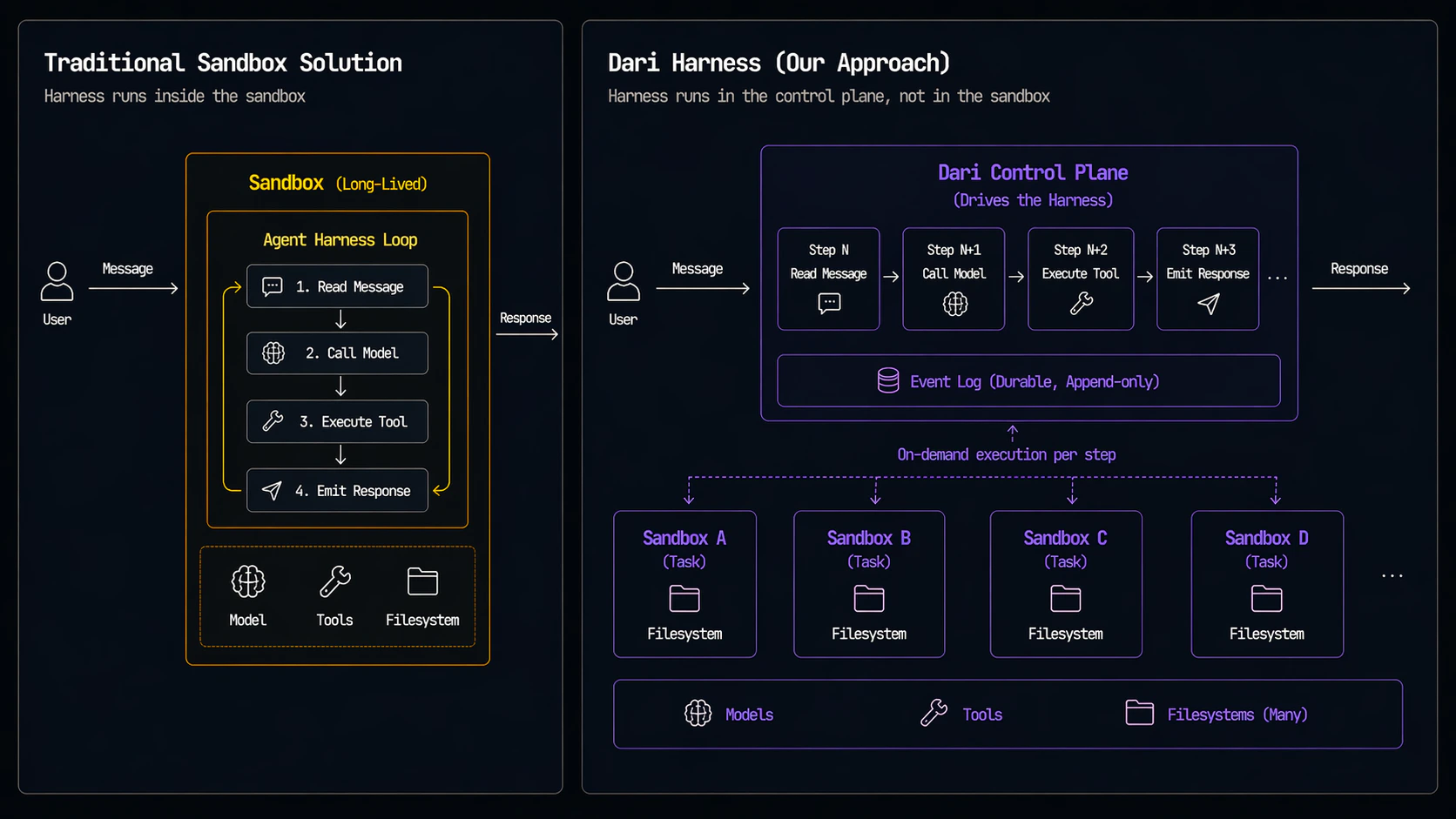
- Durable: a restarted worker picks up where the previous one left off.
- Resumable: sessions can idle between messages without a worker holding memory.
- Replayable: every step is recorded as an event.
- Scalable: a single agent can drive many sandboxes in parallel, and workers scale independently of session count.
Available harnesses
Pi
Supported today. We maintain a distributed fork of Pi so sessions can be driven one step at a time from the control plane.
More harnesses
In progress. Dari is designed so additional harnesses can plug in behind the same public API.